What schools can learn from the pandemic
At its closing conference, the research group ‘Digitising educational practice’ presented its usage model for remote instruction to education professionals.
On 2 September 2026, around 30 education professionals from Switzerland, Germany, Austria, and Liechtenstein attended the half-day closing event for the ‘Digitising educational practice’ project at the St. Gallen University of Teacher Education (PHSG). “After three and a half years of research, we want to engage today in a dialogue with people involved in education and discuss how schools can prepare for future crises,” said Valentin Unger, project leader and Head of Teacher Education at the Institute of Educational Psychology at the St. Gallen University of Teacher Education (PHSG).
Together with Julian Brauchle, a member of the research team and research assistant at the Institute of Educational Psychology at PHSG, he presented the research findings and the usage model developed based on those findings, titled ‘Physically separated teaching: Create relatedness. Provide structure. Enhance well-being.’ It was designed as a resource for education professionals and is intended to help them prepare for a future crisis.
Usage model for crisis preparedness put to the test
During a workshop, the participating professionals tested the usage model, which is designed to serve as a toolkit. Using case studies, the participants answered questions posed by the research group. In doing so, they were able to draw on the usage model as well as their individual experiences with the COVID-19 pandemic. For example, it was noted that an online check-in in the morning has proven to be a good way to verify that all students are awake and ready for remote learning. It became clear, however, that schools must tailor their lesson planning individually during times of crisis. According to Julian Brauchle, research has shown that there is no ‘one-size-fits-all’ approach to lesson planning for crisis situations. For this reason, the usage model is structured around guiding questions for schools on six core topics, such as lesson structure and student learning behaviour. QR codes link to collections of ideas, from which teachers can freely draw inspiration.
Information as a first step
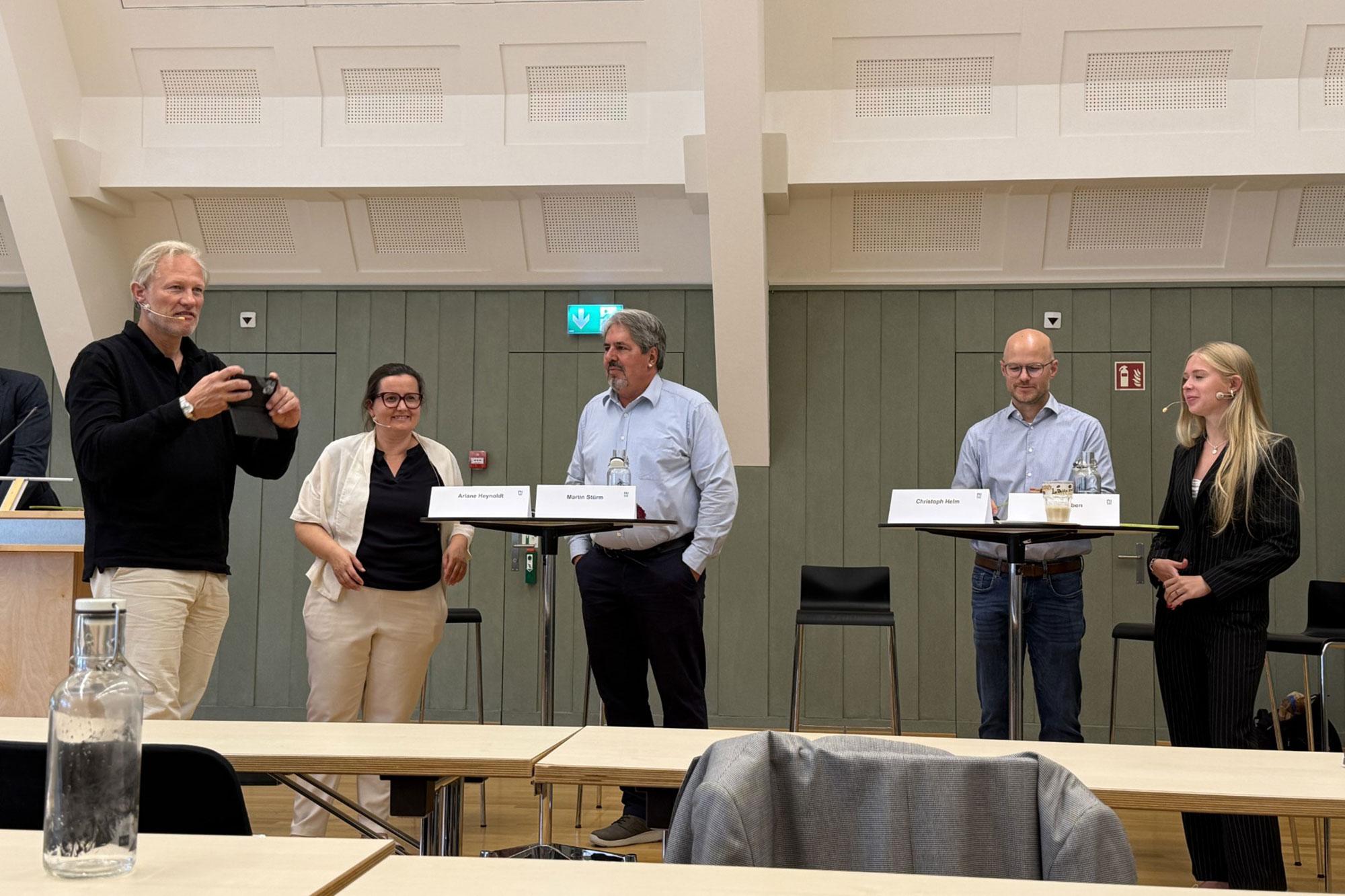
Following a ‘poster-and-coffee-session’, Stephan Huber, Head of Advisory Board of the project, moderated a panel discussion with a view to the future. He began by asking what would be needed first in a future pandemic.
For Lily Houben, National President of the Student Organization of Switzerland & Liechtenstein (USO), and Martin Stürm, Communications Officer for the Department of Education of the canton of Zurich, keeping students, teachers, and parents informed is one of the immediate measures to be taken in the event of a future crisis. As the discussion continued, the panellists identified factors that are important in preparing for a future crisis well in advance.
Teaching self-competence
Christoph Helm, Johannes Kepler University Linz, explained: “The goal must be to ensure that, in the event of a crisis, everyone has as little to do as possible.” To make schools crisis-resilient, he said, it is essential to start teaching students the skills they will need in a crisis. Well-prepared students are better able to cope with a crisis situation. This finding was also supported by research. The acquired ability to consciously control one’s own impulses, thoughts, and actions and to manage stress effectively—known as self-regulation—proved to be the most important predictor of students’ academic success and well-being during the COVID-19-related school closures. Ariane Heynoldt, a secondary level 1 practicum instructor at PHSG, also emphasized the importance of helping students develop personal skills: “Here we are currently facing a different challenge, one that we need to pay much more attention to.”
Crisis resilience vs. school culture
Martin Stürm pointed out that school culture also plays a central role in a school’s resilience to crises. He is convinced, that “we should start developing a culture of togetherness in schools.” Christoph Helm shared this view. He noted that there are frequent complaints that teachers do not collaborate enough. Teamwork is not taught at universities of teacher education, he said. Many teachers would find it difficult to relinquish control.
Identifying vulnerable students in advance
At the conclusion of the panel discussion, Stephan Huber addressed a central element of the usage model developed by the research group, focusing on the topic of 'Identifying particular vulnerabilities among students'. Lily Houben suggested that school administrators could involve peers or even the vulnerable student’s personal circle to help individual students. She said that mental health is no longer as much of a taboo topic as it used to be. Ariane Heynoldt believes that class teachers should be able to identify students about whom they are particularly concerned in the event of a crisis: “If there are vulnerable students in my class, I need to think in advance about which resources I can offer in a crisis situation.” She also expects school administrators to be sufficiently pragmatic in this regard. A home economics teacher who has a particularly good rapport with a vulnerable student could also step in to care for that student during a crisis.
As a personal takeaway, Martin Stürm concluded: “We will have to practice to become more experienced.”