
Parliament takes an interest in loneliness – Interview with psychologist Annika Rohrmoser
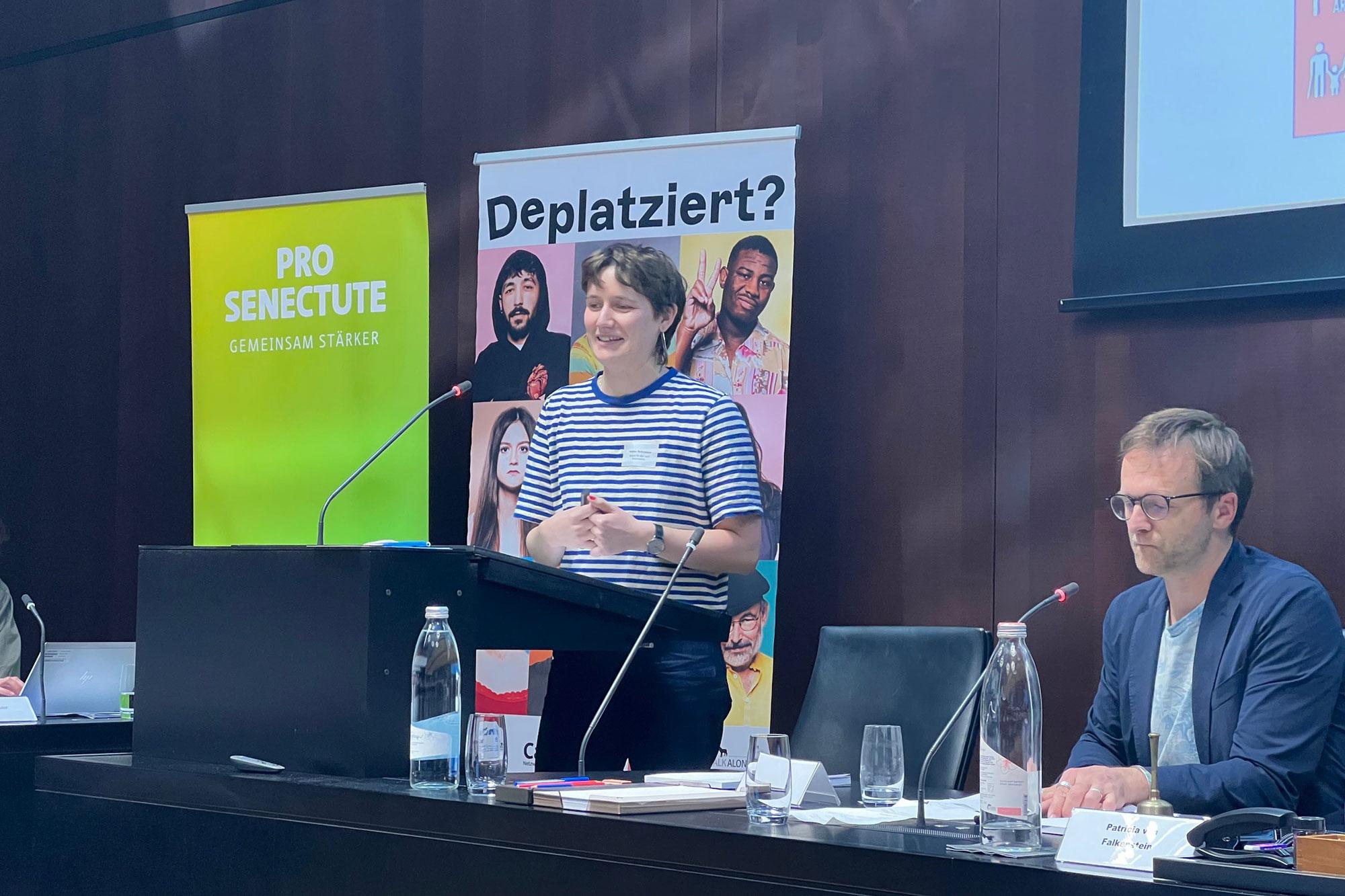
How can social isolation be effectively tackled? Annika Rohrmoser is investigating this question in the research project ‘Loneliness prevention’. She presented her findings at a parliamentary event on loneliness.
On 18 March 2026, the three parliamentary groups on ageing, children and young people, and care leaving organised the event ‘Together against loneliness: research, practice and policy in dialogue’ at the Parliament Building. The aim of the event was to bring the broad issue of loneliness to the forefront of the political agenda and to facilitate dialogue between the stakeholders involved. The NRP 80 was prominently represented by an expert presentation.
Annika Rohrmoser, a researcher at the Institute for Biomedical Ethics at the University of Basel and a PhD student on the ‘Loneliness prevention’ research project led by Professor Bernice Elger and Professor Rainer Greifeneder, spoke about ways to overcome loneliness, highlighting the different approaches to individual experiences and societal challenges. The groundwork for the presentation in the Federal Palace was laid down by the so-called 'Pairing Scheme' of the NRP 80. As part of this scheme, Annika Rohrmoser exchanged views with National Councillor Christine Bulliard-Marbach (The Centre), who co-chairs the parliamentary groups on ageing, as well as on children and youth. In the following interview, Annika Rohrmoser talks about her experiences and insights from the event in the Parliament Building:
Ms Rohrmoser, can scientists offer any recommendations or solutions to tackle loneliness to policymakers?
Yes! Of course, from a research perspective, it is not entirely straightforward to make clear recommendations and suggestions whilst maintaining the nuances, probabilities and uncertainties inherent in scientific work. Nevertheless, our work makes it clear that policymakers can create the right conditions – both by funding specific measures at the individual level, such as group sessions for psychotherapy, and by shaping the fabric of society – to ensure that fewer people are affected by intense and distressing feelings of loneliness.
As a young researcher, what insights have you gained from the event?
It was really fascinating for me to see how issues find their way into politics and how they are dealt with there. Our team is absolutely delighted that our research is generating such interest! It was wonderful for me to see how loneliness can bring together politicians from very different political camps, all of whom contributed their ideas and proposals for solutions to the discussion. It was an important exercise for me to present the results of my own work in a way that is understandable to a wider audience, without exaggerating or distorting them. The questions from the politicians following my presentation were also inspiring and motivating, encouraging me to continue my own research, while keeping the practical implications and feasibility in mind. It is to be expected that this involves a great deal of discussion about funding and responsibilities but experiencing it first-hand in the discussion at the Parliament was quite a different matter.
Which findings and recommendations did you present?
In my presentation, I briefly summarised the work we do in our research project. We have seen in our research that loneliness is often viewed as an individual problem, and that the measures examined frequently focus on the individual level. At the same time, the research shows that measures are needed at various levels to effectively address the many different forms of loneliness. In the interviews we conducted, people told us about their own experiences of loneliness. In doing so, we learnt just how diverse loneliness can be and that there is no simple one-size-fits-all solution. At the same time, the people we spoke to also told us that not everyone perceives loneliness as something negative. For some, it is a signal to seek out new contacts and hobbies or can even become an opportunity for personal development. In this respect, I have argued that loneliness should be recognised as a multifaceted phenomenon and that we should not simply aim for a complete absence of loneliness.